
Jo Daviess Scheduled Versus Actual Release
A projected release date is a calculation made from the sentence and the facts currently recorded. For an Illinois state prisoner, the public IDOC label is Projected Parole Date. It often marks the anticipated physical move from prison into mandatory supervised release for a modern determinate sentence. It is not a promise of release on that date. The later Projected Discharge Date generally concerns the end of the sentence or supervision, not the day the person leaves a prison.
Actual release is shown by a completed event. In an IDOC profile, a Last Paroled Date paired with PAROLE status and a parole-district location is stronger evidence that prison custody ended and supervision began. For the Jo Daviess County Jail, the Sheriff’s release timestamp and disposition are the key operational record. A court order supplies legal authority, but its filing or effective date can differ from the jail’s physical exit time.
Pretrial detention works differently. A person who has not received a custodial sentence usually has no sentence-based release calculation. Bond, a pretrial order, dismissal, a new court ruling, or another agency hold may control the outcome. Never force a pretrial detainee into a good-time formula.
Choose Jo Daviess Release Records
The correct lookup starts with the last known setting. A county-jail sentence, an IDOC prison sentence, and federal custody are maintained by different authorities. Leaving the Jo Daviess County Jail for IDOC is a transfer, not community release. Likewise, leaving an IDOC prison for mandatory supervised release ends prison confinement but not the state sentence.
| Last known setting | Best date source | What confirms the event |
|---|---|---|
| Jo Daviess pretrial custody | Jo Daviess court order and Sheriff record | Sheriff release or transfer timestamp and disposition |
| Jo Daviess county sentence | Sentencing order, custody credit, and jail calculation | County release entry |
| Illinois prison | IDOC Individual in Custody Search | Last Paroled Date with PAROLE status, or an IDOC release record |
| Federal sentence | BOP inmate locator and federal docket | Past release date plus the applicable agency record |
| ICE custody | ICE locator and transfer documents | ICE record, without assuming release from all custody |
A Jo Daviess court docket can show disposition, sentence, custody credit, bond or pretrial orders, a mittimus, probation, a warrant, and later discharge. A mittimus is the court document directing custody or carrying out a sentence. The docket is durable legal history, but it is not a live custody sensor.
Search Jo Daviess IDOC Release Dates
Use IDOC when the court committed the person to Illinois prison. The Individual in Custody Search accepts Last Name, IDOC Number, or Birthdate. A partial last name is allowed, but an IDOC number is more precise. The result list shows IDOC number, date of birth, and name. Open the correct profile only after matching those details.
- Open the IDOC Individual in Custody Search.
- Use the IDOC number when known, or search by last name or birthdate.
- Match the result by name, birth date, and IDOC number.
- Read Offender Status and Location before any date.
- Review Admission Date, Projected Parole Date, Last Paroled Date, and Projected Discharge Date.
- Check each sentence row, county, and “Sentence Discharged?” label.
- Confirm a completed release with IDOC or the sentencing court if the result is unclear.
The official IDOC search form shows the available public inputs.
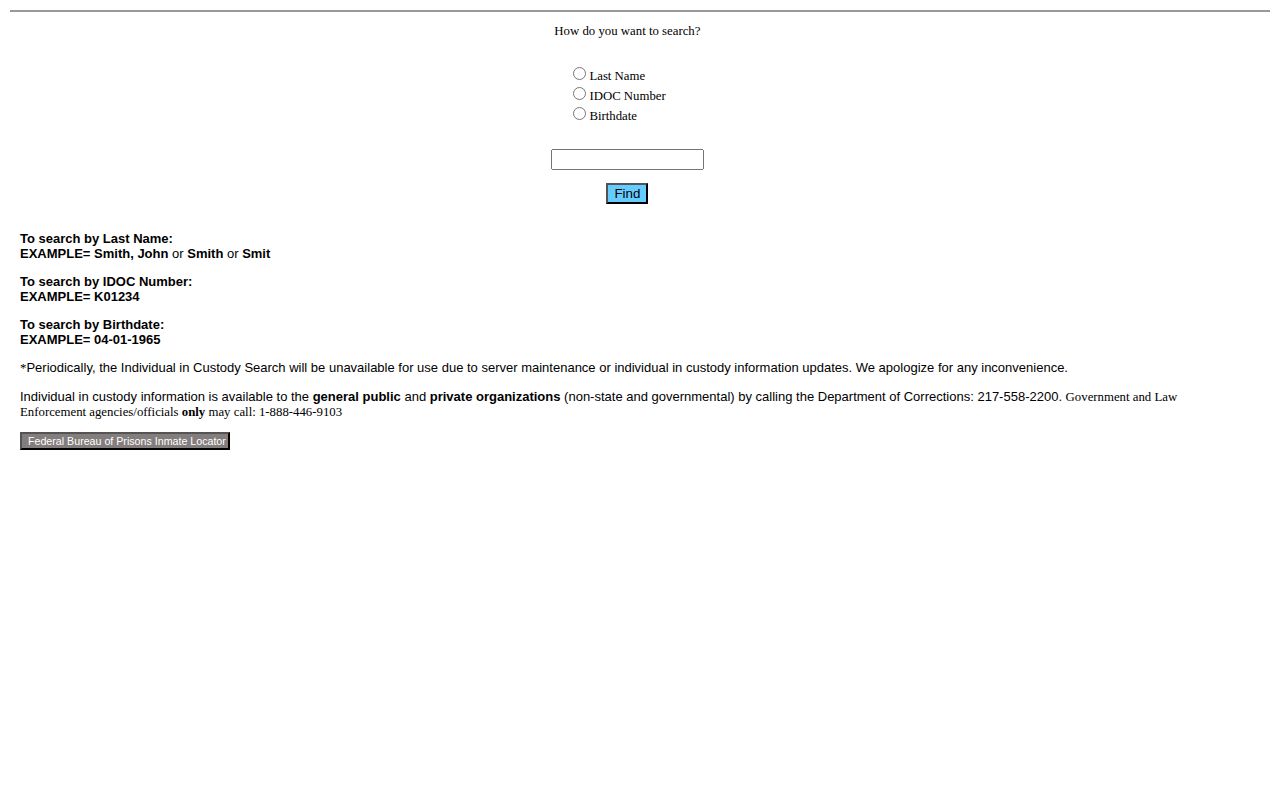
These fields belong to state corrections. A person who served only in the Jo Daviess County Jail may have no IDOC result at all.
Statuses change the meaning. PAROLE means release from prison into state supervision. ABSCONDER means the person is alleged to be absent from supervision, not discharged. A prison location indicates current IDOC confinement. Fully discharged people can disappear from the public search, so no result does not prove that the person never entered state custody.
Read Jo Daviess IDOC Date Labels
Preserve the label attached to each date. Projected Parole Date and Projected Discharge Date describe different points. Last Paroled Date records a past event. A sentence row marked discharged can coexist with another active sentence, so one “YES” should not be applied to the whole record without checking every row.
| IDOC field | Meaning and limit |
|---|---|
| Admission Date | When IDOC recorded the state-custody admission, not the original arrest date. |
| Projected Parole Date | Estimated physical release point based on the current state calculation. |
| Last Paroled Date | Historical evidence of release to parole or mandatory supervised release. |
| Projected Discharge Date | Estimated end of sentence or supervision, often later than prison release. |
| Offender Status and Location | Shows whether the person is confined, on parole, or listed in another state status. |
| Sentence Discharged? | Applies to the displayed sentence row and must be read with other sentences. |
An official IDOC result view demonstrates how status, location, and admission or release fields appear together.
The profile layout reinforces why identity, status, and sentence rows must be read before a projected date is repeated.
Illinois Credits Shape Jo Daviess Dates
Illinois sentence credit does not follow one percentage for every conviction. The controlling framework is 730 ILCS 5/3-6-3. For many offenses outside restricted groups, the statutory scheme can effectively provide one day of credit for each day served, often summarized as one-half of the imposed term. Eligibility, offense date, and sentence terms still control.
Some categories have stricter floors. First-degree murder, terrorism, and specified sex-offense categories receive no sentence credit under the cited provisions. Listed violent offenses generally allow no more than 4.5 days of credit per month, commonly described as about 85 percent served. Certain listed drug offenses use a 7.5-day-per-month limit. These summaries cannot determine one person’s date because the exact conviction and governing version of the statute matter.
The law also permits discretionary earned sentence credit in some cases. The maximum can be up to 180 days for sentences under five years and up to 365 days for sentences of five years or more, subject to eligibility and a required period served. Qualifying programs and other credit categories have their own rules and exclusions. IDOC warns that eligibility does not promise an award and that staff cannot predict an individual award in advance.
Modern determinate sentences typically lead to mandatory supervised release rather than a routine discretionary parole-board vote. Older indeterminate cases and separate youthful or medical provisions follow other paths. This is why IDOC can label a modern estimate “Projected Parole Date” even though the person may not await the old form of discretionary parole.
Why Jo Daviess Release Dates Move
A sentence calculation changes when the facts used in it change. IDOC calculates determinate sentences toward projected and mandatory release dates. It aggregates consecutive sentences and accounts for concurrent structure, custody credit, statutory credit, and recorded adjustments. Corrections to a mittimus or presentence credit can alter the starting inputs.
| Factor | Possible effect |
|---|---|
| Credit earned or awarded | May move the projected date earlier within statutory limits. |
| Credit revoked or restored | Can move the projection later or earlier after discipline and review. |
| Corrected court order | May change sentence terms or custody credit used in the calculation. |
| Consecutive or concurrent terms | Changes how multiple sentences combine. |
| Escape, violation, or other absence | Can affect credited time and the mandatory date under governing rules. |
| Detainer or hold | May not change arithmetic but can change where the person goes next. |
| Parole or revocation action | Can affect supervision, return to custody, and later recalculation. |
A detainer is a request or notice from another authority concerning custody. It can mean that release from one sentence leads to transfer rather than freedom in the community. A projected date should therefore answer when one custody calculation is expected to reach its release point, not where the person will be afterward.
Jo Daviess County Sentence Timing
Do not apply the IDOC Projected Parole Date rules to a county-only sentence. The Jo Daviess sentencing order, court-awarded custody credit, the County Jail Good Behavior Allowance Act, and local administration govern that calculation. The official jail page says sentenced inmates are released at 8:00 a.m. unless the sentencing order states otherwise. That narrow rule does not set the timing for bond release, pretrial release, transfers, or other court-ordered outcomes.
Ask the Jo Daviess County Jail and Circuit Clerk for the existing records behind the date. Useful documents include the sentencing order, custody-credit entry, mittimus, jail calculation, release authorization, and final release log entry. The jail is in the Public Safety Building at 330 North Bench Street in Galena, and the Sheriff’s general number is 815-777-2141. State the person’s full name, known birth date, case or booking number, and the exact date field being questioned.
A county booking that ends with transfer to IDOC is not a Jo Daviess community release. Search IDOC after intake. If another county, federal agency, or immigration authority receives the person, follow that named destination. A vanished local booking entry alone cannot identify what happened, especially because Jo Daviess County does not publish a public current roster.
Confirm Jo Daviess Release Dates
For a pending state release, compare the IDOC profile with the sentence and court judgment. IDOC directs requests for written confirmation to its Public Information Office at 1301 Concordia Court, P.O. Box 19277, Springfield, IL 62794-9277. The general public information line is 217-558-2200. If the profile later disappears, use IDOC and court records because final discharge can be one reason a person is omitted from public results.
For county custody, use the Sheriff timestamp and disposition. For legal authority, use the Jo Daviess Judici docket or request the order directly from the Circuit Clerk. Court records are not obtained through county FOIA. VINE can send a custody-change alert, but it may lag or describe a transfer. The Jo Daviess VINELink release check explains how to register against the right record and verify the alert.
Keep arrest, admission, sentence, projected parole, last paroled, projected discharge, and actual release dates separate. They measure different events. A sound conclusion names the agency, identifier, exact date label, status, and access date, then checks a completed event with the office that created it.